
Stains & whiteness
Baking soda to whiten teeth: what works (and the precautions)
Thinking of using baking soda to whiten your teeth? It's a genuinely effective idea — but only if it's dosed correctly. Baking soda is a gentle abrasive that lifts surface stains; used raw and rubbed too hard, it can wear down the enamel and irritate the gums. Here's how it really works, and why a properly dosed baking-soda toothpaste is the safest everyday choice.
- Gentle, dosed abrasion
- Fluoride 1450 ppm
- Shipped from France
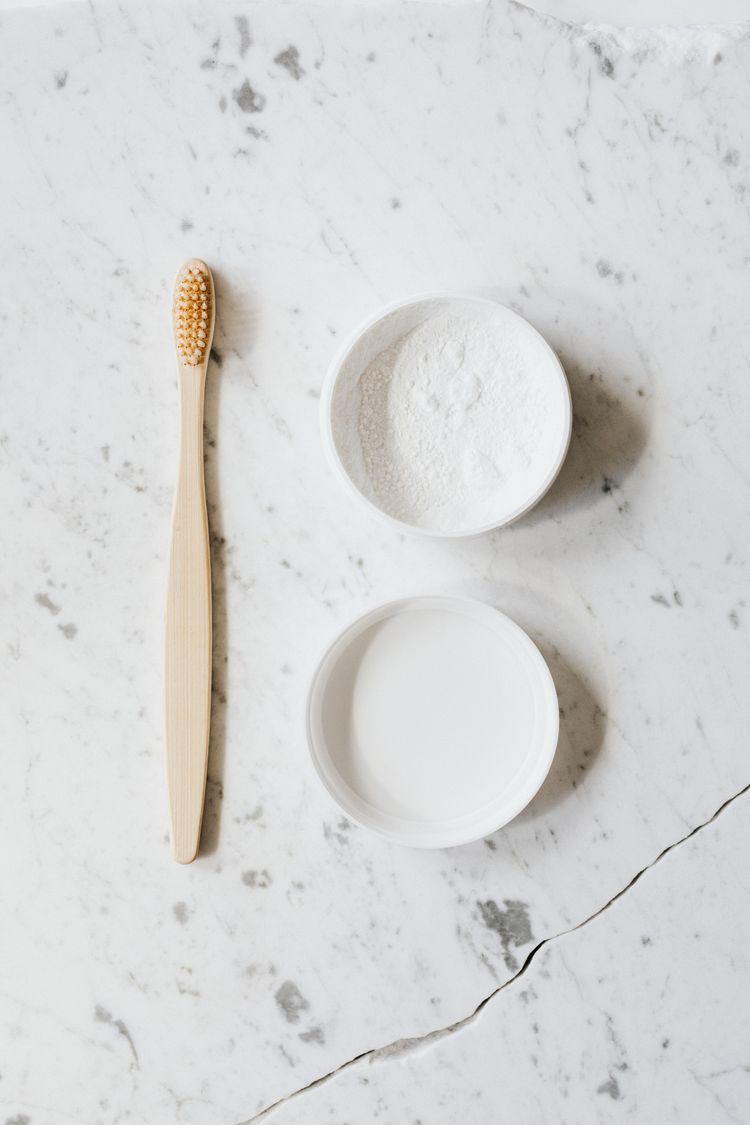
How does baking soda whiten teeth?
Baking soda (sodium bicarbonate) is a fine mineral powder with a low abrasiveness. When you brush, its micro-crystals mechanically dislodge the coloured deposits that cling to the surface of the enamel — coffee, tea, tobacco, red wine. It also slightly neutralises the acidity of the mouth, which is useful after an acidic meal. In short: it polishes and cleans, gently, without chemical bleaching.
One important point: baking soda acts on extrinsic stains (on the surface). It does not change the internal shade of the tooth — for that, only a treatment supervised by a dentist is suitable. And raw baking soda has no dosing: rubbed too often or too hard, it can end up wearing the enamel and irritating the gums.
The solutions that really work
Three levers, from the safest daily option to the occasional boost:
- A dosed baking-soda toothpaste every day: this is the best compromise. The Sea Salt & Baking Soda toothpaste gives you the polishing action of baking soda at a controlled abrasiveness, with fluoride — safe for daily use.
- Activated charcoal, once or twice a week: the Whitening Activated Charcoal captures surface pigments as a supplement. Alternate it rather than overusing it, to protect the enamel.
- Raw baking soda, occasionally at most: if you use the pure powder, keep it to once a week, brush gently with a soft brush, and never mix it with lemon — the acidity attacks the enamel.
| Method | On surface stains | Good to know |
|---|---|---|
| Dosed baking-soda toothpaste | Effective every day | Controlled abrasion, unlimited use |
| Activated charcoal | Effective as a supplement | 1-2×/week, no more |
| Raw / homemade baking soda | Effective but undosed | Once a week at most, brush gently |
| Lemon + baking soda | Not recommended | The acidity erodes the enamel |
The tip that changes everything: it's not the abrasiveness that removes stains, it's consistency. A correctly dosed toothpaste used morning and evening does more — and is far gentler — than an occasional aggressive scrub with raw powder.
Our baking-soda whitening routine
 Sea Salt & Baking SodaThe daily go-to: dosed baking soda, gentle polishing.See the product →
 Whitening Activated CharcoalThe 1-2×/week supplement to capture pigments.See the product →
 Natural Detox PackThe complete routine — free delivery.See the pack →
To go further, browse our smile blog.
Your questions about baking soda
Does baking soda damage the enamel?
In a correctly dosed toothpaste, no: the abrasiveness is controlled. It's raw powder, rubbed too hard or too often, that can wear the enamel and irritate the gums. Prefer a dosed toothpaste for daily use and keep pure baking soda for occasional use.
How often can I use baking soda?
A dosed baking-soda toothpaste can be used every day, morning and evening. Raw powder, on the other hand, should be limited to once a week at most, applied gently with a soft brush.
Does baking soda really whiten teeth?
It acts on surface stains and restores the teeth's natural shade. It doesn't whiten the internal shade of the tooth: for whitening beyond that, only a dentist can intervene.
Raw baking soda or a baking-soda toothpaste?
The toothpaste, for daily use: same polishing action but at a controlled abrasiveness, with fluoride and no risk of over-dosing. Raw powder remains an occasional option, never a daily one.
Baking soda works. That is precisely what makes it dangerous: because you see a result in the first few days, you do it again — and it is the repetition that causes damage, not the product.
Here is what it actually does, how often it stays risk-free, and why the dosed version inside a toothpaste is not a commercial compromise but the right way to use it.
What baking soda does (and does not do)
Sodium bicarbonate is a mild abrasive. Its crystals mechanically lift pigments deposited on the surface of the enamel: coffee, tea, tobacco, wine. It also has an alkalising effect that neutralises part of the acidity in the mouth — useful, but secondary.
What it does not do: whiten. There is no oxidising agent in baking soda, therefore no action on the deep colour of the tooth. It cleans a surface; it does not change the shade of the dentine. If your teeth are naturally ivory, it will change nothing, however diligent you are.
This is the most common confusion: "it worked on my stains" becomes "it whitens teeth". The two are not the same thing, and that confusion pushes people to use more and more once the result plateaus.
The real risk: cumulative wear
Enamel does not regenerate. Once worn, it is worn for good — and thinned enamel has two unfortunate consequences: it lets more of the yellower dentine show through, and its surface becomes more porous, so more receptive to stains.
In other words: baking soda used to excess ends up producing the opposite of what you were after. Teeth that look yellower and stain faster.
| Use | Verdict |
|---|---|
| Pure powder, several times a week | No — cumulative enamel wear |
| Pure powder, occasionally (once a month), without scrubbing | Low risk |
| Baking soda dosed in a formulated toothpaste | Yes, daily use possible |
| Mixed with lemon | No, never — the acidity makes everything worse |
Why a dosed toothpaste beats the powder
This is not a question of brand, it is a question of measurement. A toothpaste brings three things pure powder does not have:
- Controlled abrasiveness. The RDA of a toothpaste is measured; that of a spoonful of baking soda rubbed on by hand is not — it depends on your pressure and on how fine the crystals are.
- Fluoride. The powder alone contains none: you are cleaning with no protection against decay for the duration of that brushing.
- Agents that limit direct contact between the crystals and the enamel while keeping the polishing effect.
That is the principle behind the Sel Marin & Bicarbonate toothpaste: the baking soda is present at a dose that cleans without regularity becoming a problem. The detail of the benefits and the limits is in baking soda and sea salt: real benefits and myths.
If you are set on pure powder
It is not forbidden, provided you follow three rules:
- Once a month at most, no more.
- Without scrubbing. Apply, leave briefly, rinse. It is friction that wears, not contact.
- Never with lemon or any acid. The "abrasive + acid" combination is the worst of both worlds: the acid softens the enamel that the abrasive then strips.
And keep your fluoride toothpaste for your usual brushings: baking soda alone protects against nothing.
Frequently asked questions
Baking soda or activated charcoal?
Both act by polishing, with different textures. The choice depends mainly on the formulation, not the ingredient: badly dosed charcoal damages just as much as badly dosed baking soda. The comparison is set out in charcoal or baking soda: which to choose.
How long before I see a result?
On surface stains, two to three weeks of regular use of a suitable toothpaste. Pure powder gives the impression of a faster result, but that is stripping — not lasting cleaning.
Is food-grade baking soda the same as "dental" baking soda?
Chemically, yes. What differs is how fine the crystals are: the coarser they are, the more they scratch. One more reason to prefer a formulation designed for the mouth.
Does it damage crowns or veneers?
Prosthetic materials do not behave like enamel and can dull or scratch. If you have visible restorations, ask your dentist before adopting a regular abrasive product.
In short
Baking soda is a good surface cleaner and a poor whitener. Used at a controlled dose in a toothpaste, it allows regularity — which is what actually produces results. Used pure and often, it ends up wearing away what it was meant to show off.
To place baking soda among the other methods, see whitening teeth naturally: what really works. To choose according to your habits, the two-minute quiz and the buying guide.
This information is general in nature and does not replace the advice of a dentist. If you have sensitivity or any doubt about the state of your enamel, consult a professional.
In summary
Baking soda is a gentle, effective ally against surface stains — provided it's dosed. A daily baking-soda toothpaste, an occasional charcoal and a few good habits are enough to revive the shine, without harming the enamel. Not sure which formula suits your smile? Our toothpaste quiz guides you in two minutes.
 Revive my smile